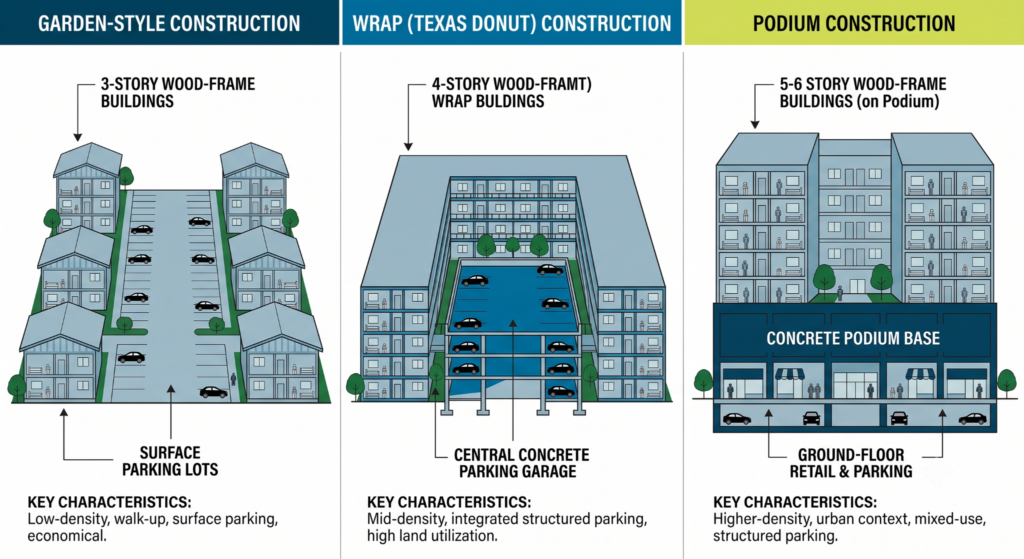
The right multifamily product type is decided mostly by the site you’re working with, not necessarily your preference. Garden-style fits larger, lower-cost land parcels with modest density and surface parking needs. Wrap construction (the “Texas donut”) fits urbanizing infill sites that need higher density and structured parking but cannot support the cost of a full concrete podium. Podium construction fits high-value infill where density targets, ground-floor retail, or mixed-use programming justify a concrete base. Match the format to your land cost per unit, density target, and parking constraint, and the budget, unit count, and schedule fall into line.
This guide breaks down each product type’s construction method, cost, density potential, and market fit, and shows where an experienced apartment general contractor adds the most value.
What’s the Difference Between Garden-Style, Wrap, and Podium Apartments?
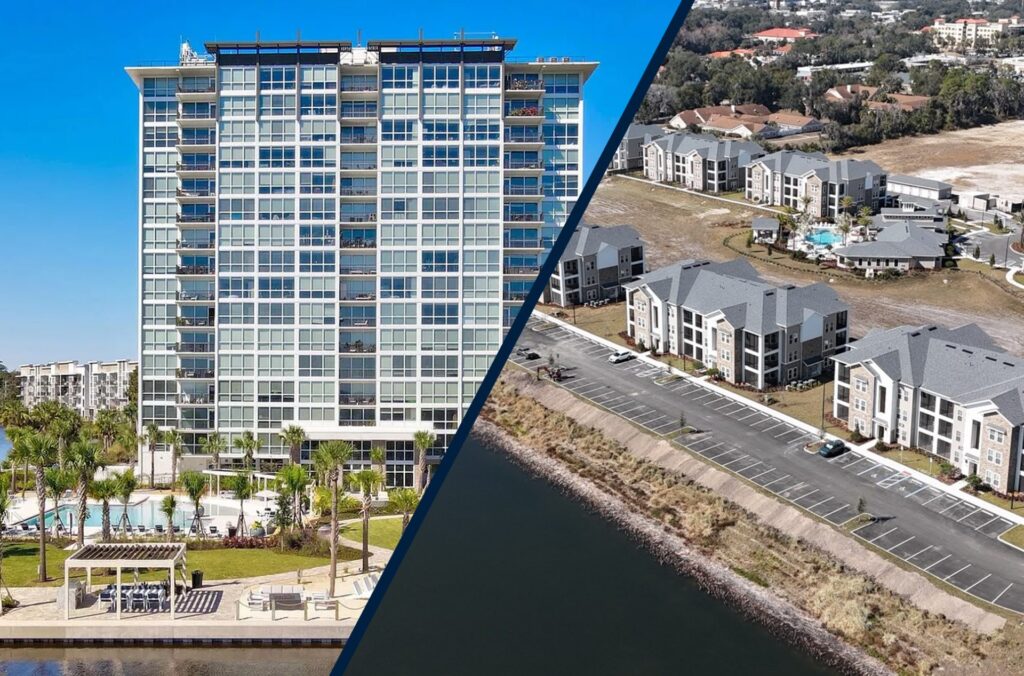
All three are low-rise to mid-rise multifamily units built primarily with wood framing, which is why they often compete for the same sites. But there are key differences in how they handle parking and the density they achieve.
Garden-Style Apartment Construction, and When It Makes Sense
Garden-style is 2 to 4 stories of all-wood-frame buildings over surface parking, and it makes sense on larger, land-available parcels where cost discipline and speed matter more than maximizing density. It is the least expensive of the three formats, with current industry hard costs around $130 to $190 per square foot and density near 15 to 30 units per acre.
It delivers on the shortest schedule, because an all-wood-frame community over surface parking avoids the concrete-deck sequencing that lengthens wrap and podium jobs.
Garden-style is the dominant choice across the Southeast and Sun Belt for market-rate, senior living, affordable, and build-to-rent communities, and the real skill for a garden-style apartment builder is managing multiple buildings and phased turnovers at once.
Wrap (Texas Donut) Construction, and When It Makes Sense
Wrap is 4 to 5 stories of wood-frame apartments wrapped around a central above-grade concrete parking deck, and it makes sense on urbanizing infill sites that need higher density and structured parking but cannot yet support a full podium’s cost.
It reaches roughly 50 to 90 units per acre on a site as small as 1.5 to 3 acres, at current industry hard costs near $200 to $275 per square foot. The wood-frame apartments stay relatively inexpensive; what adds cost over garden-style is the concrete deck and the deeper site work it requires. Because the residential scope is squarely wood-frame, a wood-frame apartment general contractor is well-positioned for this format, as long as it can coordinate the deck as a separate structural system.
LandSouth builds both halves of that equation: decades of wood-frame residential delivery, plus structured parking and commercial scopes coordinated within its mixed-use projects. That combination is the core of what a wrap demands.
Podium Construction, and When It Makes Sense
Podium is several stories of wood-frame apartments built on a concrete podium, and it makes sense on high-value infill where the density target and ground-floor retail or mixed-use programming justify the concrete base.
It is the highest-density wood-frame apartment the code allows, reaching 80 to 120-plus units per acre, and the most expensive of the three at current industry hard costs near $235 to $350 per square foot. It also carries the longest schedule and the most demanding review, since the podium must be built before the wood framing, and mixed-use adds commercial code and retail coordination.
Choosing a podium multifamily contractor with real experience running residential, structured parking, and commercial scopes in parallel matters more here than on any other format.
How Do They Compare on Cost, Density, and Timeline?
| Factor | Garden-style | Wrap (Texas donut) | Podium (5-over-1) |
| Stories | 2 to 4 | 4 to 5 | 5 to 7 |
| Structure | All wood frame (Type V) | Wood frame around a concrete deck | Wood frame over a concrete podium |
| Density | ~15 to 30 units/acre | ~50 to 90 units/acre | ~80 to 120+ units/acre |
| Parking | Surface, uncovered | Structured, central deck | Structured podium |
| Hard cost (2026) | ~$130 to $190 / sq ft | ~$200 to $275 / sq ft | ~$235 to $350 / sq ft |
| Typical site | 8 to 20+ acres | 1.5 to 3 acres | Infill, high land value |
| Relative schedule | Shortest | Moderate | Longest |
| Best fit | Land-available suburban and Sun Belt | Urbanizing infill | High-value urban infill, mixed-use |
Current industry benchmarks for 2026. The dollar ranges are market-specific, not fixed quotes, and vary by metro.
Which Builders Have the Most Experience with These Product Types?
Experience is not interchangeable across product types, so it’s important to match a builder’s demonstrated depth to your specific needs. Among multifamily construction companies in the Southeast, LandSouth’s deepest and most demonstrable strength is wood-frame multifamily at scale, with garden-style at the center. For more than 28 years, LandSouth has built its reputation delivering garden-style communities across the Southeast region, backed by roughly 80 percent repeat business, which is the profile of a proven wood-frame apartment builder and garden-style apartment contractor.
That experience extends across market-rate and luxury mid-rise, senior living, affordable and HUD-financed housing, and mixed-use developments that run residential, parking, and commercial scopes in parallel. For a developer weighing a garden against a denser podium or mixed-use format, that range means the conversation can center on what the site supports rather than on what a single-format builder is equipped to deliver. As an employee-owned firm, LandSouth also brings an ownership culture to the field that strengthens subcontractor relationships and schedule reliability.
Frequently Asked Questions
Which is Cheapest to Build: Garden-Style, Wrap, or Podium?
Garden-style is the least expensive of the three, at current industry hard costs near $130 to $190 per square foot, because it uses wood framing throughout with surface parking and no structured-parking premium. Wrap runs about $200 to $275 per square foot and podium about $235 to $350, with the concrete parking structure driving most of the difference. Costs vary by market and have trended toward the higher end of these ranges in 2026.
How Many Units Per Acre Can Each Product Type Achieve?
Garden-style typically yields 15 to 30 units per acre, wrap 50 to 90, and podium 80 to 120 or more. Density rises with each format because parking moves from a surface lot to a structured deck to an integrated concrete base, freeing up land for units.
Which Product Type Is Fastest to Build?
Garden-style delivers on the shortest schedule, because an all-wood-frame community over surface parking avoids the concrete-deck sequencing that adds time to wrap and podium jobs. Podium carries the longest schedule of the three, since the concrete base has to be built before the wood framing and mixed-use programming add commercial coordination.
Not Sure Which Style Fits Your Site?
If you are deciding between garden-style, wrap, and podium for a Southeast site, start with a product-type conversation grounded in your land basis, density target, and parking constraints before design locks in. As a firm with decades of wood-frame delivery behind it, LandSouth can help pressure-test which format gives your site the best mix of density, cost, and schedule.
Contact us today to talk through your options.